After youcreate an advanced AI agent, you need to connect it to Zendesk Support before the AI agent can begin responding to customers by email. Email responses sent by the AI agent are sent as thesystemuser, meaning no agent seat is required for an advanced email AI agent.

What's my plan?
Add-on AI agents - Advanced

After you create an advanced AI agent, you need to connect it to Zendesk Support before the AI agent can begin responding to customers by email. Email responses sent by the AI agent are sent as the system user, meaning no agent seat is required for an advanced email AI agent.

Note: When you created your AI agent, you must have selected a channel type of email. If you selected messaging, see Setting an advanced AI agent as the default responder for a messaging channel instead.

You should connect only one advanced AI agent to email. For advice on how to handle brand-specific information within a single AI agent, see Can I connect multiple advanced AI agents to a single Zendesk account?

This article covers the following topics:
  • Connecting an advanced AI agent to your subdomain
  • Configuring the sender of advanced AI agent email responses (Optional)
  • Creating the automation trigger and turning on the automation engine
  • Disconnecting an advanced AI agent from email

Connecting an advanced AI agent to your subdomain

The first step in connecting an advanced AI agent to email is to connect to your production or sandbox environment.

To connect an AI agent to your subdomain

  1. In AI agents - Advanced, select the advanced AI agent you want to work with.
  2. Click Settings in the sidebar, then select CRM integration.
  3. Click Select your CRM and select Zendesk Support.
  4. Select the Integration tab.
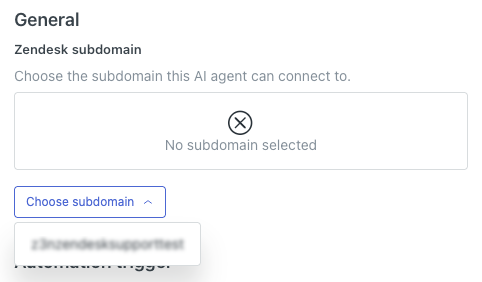
  5. Click Choose subdomain and select the subdomain for either your production or sandbox environment.
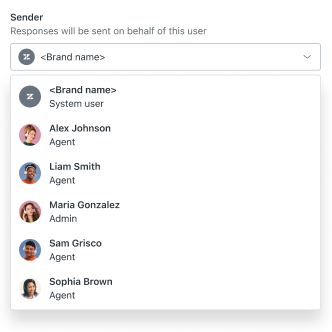
  6. Under Sender, click the drop-down field and select the user that appears in tickets as the sender of the AI agent response.

    This user appears as the sender only when the ticket is viewed in the Agent Workspace. When a customer receives an AI agent email response in their inbox, the sender appears as the brand name and support address you’ve selected in Admin Center.

    For more information on this setting, see Configuring the sender of advanced AI agent email responses (Optional).

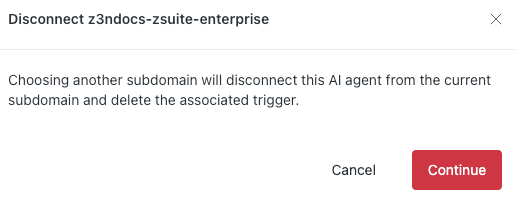
  7. In the confirmation dialog, click Continue.
Configuring the sender of advanced AI agent email responses (Optional)

Email responses sent by an advanced AI agent can be viewed in two places:

  • As actual emails that arrive in the customer’s inbox
  • As public comments in the associated ticket in the Agent Workspace

The user listed as the sender of the AI agent’s email responses is different depending on which channel the ticket was created through and which place you’re viewing.

In tickets created through the email channel:

  • In the email in the customer’s inbox, the sender is the brand name and support address you’ve selected in Admin Center.
  • In the ticket in the Agent Workspace, the sender is the system user by default, but this sender can be configured.
    • If you use the default system user:
      • The AI agent’s response is shown as coming from the system user.

      • No agent seat is consumed in your account.
    • If you select a different user:
      • The AI agent’s response is shown as coming from the selected user, including their name, email, and signature (if configured).

      • An agent seat is consumed in your account by the selected user.

In tickets created through the web form and API channels:

  • If you use the default system user:
    • The AI agent’s response is shown as coming from the Zendesk user in both the customer’s inbox as well as in tickets in the Agent Workspace.

    • No agent seat is consumed in your account.
  • If you select a different user:
    • The AI agent’s response is shown as coming from the selected user, including their name, email, and signature (if configured).
    • An agent seat is consumed.

Whether you should use the system user or a different user depends on your setup and goals:

  • Use the system user if you:
    • Don’t use the web form or API channels for customer support.
    • Want to free up an agent seat.
  • Use a different user if you:
    • Use the web form or API channels in addition to the email channel for customer support.
    • Want increased branding and customization for the AI agent’s responses as seen in tickets in the Agent Workspace.

If you use a different user as the sender of advanced AI agent email responses, it’s recommended to create a dedicated user that’s used only for this purpose. You shouldn’t reuse a human agent’s account as the sender of the AI agent’s email response. Doing so can cause confusion about whether the human agent or AI agent sent the response.

To create and configure the sender of advanced agent email responses

  1. (Recommended) Create a unique company email address for your AI agent.
  2. Add the AI agent as a user with the following roles:
    • Support: Admin
    • AI agents: Client admin
  3. Create a group and add only the AI agent user to that group.

    Don't add the AI agent user to any other groups.

  4. Give the AI agent user API access for ticketing.
  5. In AI agents - Advanced, select the advanced AI agent you want to work with.
  6. Click Settings in the sidebar, then select CRM integration.
  7. Select the Integration tab.
  8. Under Sender, click the drop-down field and select the user you created above.

    This user appears in tickets as the sender of the AI agent response.

  9. If you’re updating the user after the email automation trigger has already been created, edit the trigger to update its conditions as necessary to account for the selected user.

Creating the automation trigger and turning on the automation engine

After you connect to your subdomain, you need to create the automation trigger and turn on the automation engine. This allows the advanced AI agent to send replies to customer requests on the email channel.

Important: If you don't set up the automation trigger, any replies made by human agents during conversations in which the email AI agent also participated don't appear in the conversation logs. As a result, automated resolutions might be consumed for conversations they shouldn't be.
To create the automation trigger and turn on the automation engine
  1. In AI agents - Advanced, select the advanced AI agent you want to work with.
  2. Click Settings in the sidebar, then select CRM integration.
  3. Select the Integration tab.
  4. Click Create automation trigger.

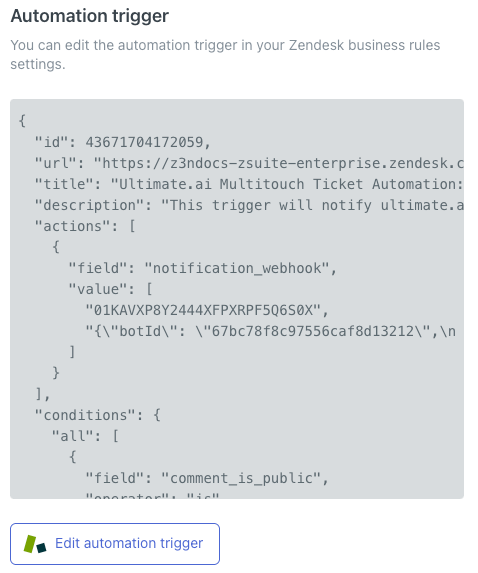
    The trigger is automatically created. You can view the details of the JSON in a read-only text window, and edit the trigger if needed.
  5. Select the Overview tab.
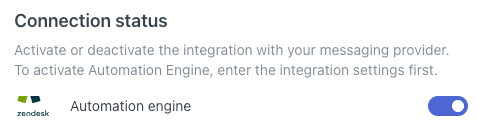
  6. Select Automation engine to toggle it on.
Your AI agent is now connected to email. At this point, you may want to:

  • Manage the automation trigger to reorder it in your list of triggers or edit its default configuration.
  • Import ticket data to populate the AI agent’s conversation logs with historical data from Zendesk Support.

Disconnecting an advanced AI agent from email

If you no longer want an AI agent to be connected to email, you can turn off the automation engine and deactivate the trigger.

To disconnect an advanced AI agent from email
  1. In AI agents - Advanced, select the advanced AI agent you want to work with.
  2. Click Settings in the sidebar, then select CRM integration.
  3. Select the Overview tab.
  4. Select Automation engine to toggle it off.
  5. In the confirmation dialog, select Turn off.

    At this point, the AI agent is still technically connected to the email channel, but it won’t respond to customer requests.

  6. Select the Integration tab.
  7. Click Deactivate automation trigger.
  8. (Optional) Select the Overview tab again, click Remove integration, and then click Confirm in the confirmation dialog.

Your AI agent is no longer connected to email.

Powered by Zendesk